K. Rasa, A. Quiroga, H. Campo, P. Fullmer, P. Teepe, and W. Amonette.
Journal of Strength and Conditioning Research: 2025. DOI: 10.1519/JSC.0000000000005357
Purpose
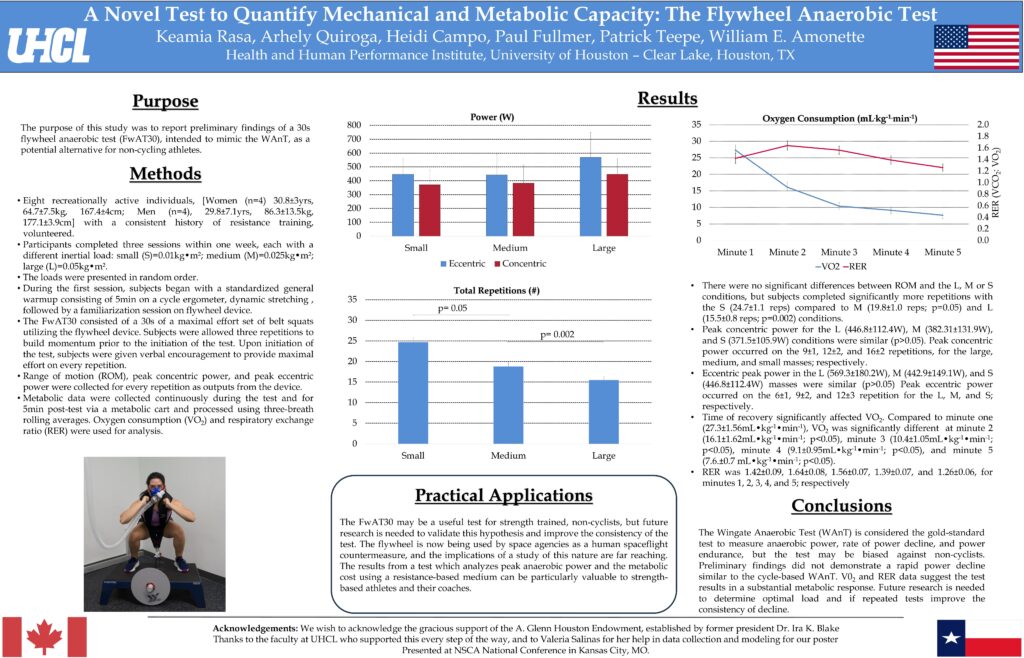
The purpose of this study was to report preliminary findings of a 30s flywheel anaerobic test (FwAT3030), intended to mimic the WAnT, as a potential alternative for non-cycling athletes.
Methods
Eight recreationally active individuals, [Women (n=4) 30.8±3yrs, 64.7±7.5kg, 167.4±4cm; Men (n=4), 29.8±7.1yrs, 86.3±13.5kg, 177.1±3.9cm] with a consistent history of resistance training, volunteered. Participants completed three sessions within one week, each with a different inertial load: small (S)=0.01kg•m²; medium (M)=0.025kg•m²; large (L)=0.05kg•m². The loads were presented in random order. During the first session, subjects began with a standardized general warmup consisting of 5min on a cycle ergometer, dynamic stretching, followed by a familiarization session on flywheel device. The FwAT30 consisted of a 30s of a maximal effort set of belt squats utilizing the flywheel device. Subjects were allowed three repetitions to build momentum prior to the initiation of the test. Upon initiation of the test, subjects were given verbal encouragement to provide maximal effort on every repetition. Range of motion (ROM), peak concentric power, and peak eccentric power were collected for every repetition as outputs from the device. Metabolic data were collected continuously during the test and for 5min post-test via a metabolic cart and processed using three-breath rolling averages. Oxygen consumption (VO2) and respiratory exchange ratio (RER) were used for analysis
Results
There were no significant differences between ROM and the L, M, or S conditions, but subjects completed significantly more repetitions with the S (24.7±1.1reps) compared to M (19.8±1.0reps; p=0.05) and L (15.5±0.8reps; p=0.002) conditions. Peak concentric power for the L (446.8±112.4W), M (382.31±131.9W), and S (371.5±105.9W) conditions were similar (p>0.05). Peak concentric power occurred on the 9±1, 12±2, and 16±2 repetitions, for the large, medium, and small masses; respectively. Eccentric peak power in the L (569.3±180.2W), M (442.9±149.1W), and S (446.8±112.4W) masses were similar (p >0.05) Peak eccentric power occurred on the 6±1, 9±2, and 12±3 repetition for the L, M, and S; respectively. Time of recovery significantly affected VO2. Compared to minute one (27.3±1.56ml•kg-1•min-1), VO2 was significantly different at minute 2 (16.1±1.62mL•kg-1•min-1; p< 0.05), minute 3 (10.4±1.05mL•kg-1•min-1; p< 0.05), minute 4 (9.1±0.95mL•kg-1•min-1; p< 0.05), and minute 5 (7.6.±0.7 mL•kg-1•min-1; p<0.05). RER was 1.42±0.09, 1.64±0.08, 1.56±0.07, 1.39±0.07, and 1.26±0.06, for minutes 1, 2, 3, 4, and 5; respectively.
Conclusions
The Wingate Anaerobic Test (WAnT) is considered the gold-standard test to measure anaerobic power, rate of power decline, and power endurance, but the test may be biased against non-cyclists. Preliminary findings did not demonstrate a rapid power decline similar to the cycle-based WAnT. V02 and RER numbers suggest the test results in a substantial metabolic response. Future research is needed to determine optimal load and if repeated tests improve the consistency of decline.
Practical Applications
The FwAT3030 may be a useful test for strength trained, non-cyclists, but future research is needed to validate this hypothesis and improve the consistency of the test.
Acknowledgements
None