H. Campo, P. Teepe, P. Fullmer, K. Rasa, A. Quiroga, and W. Amonette.
Journal of Strength and Conditioning Research: 2025. DOI: 10.1519/JSC.0000000000005357
Purpose
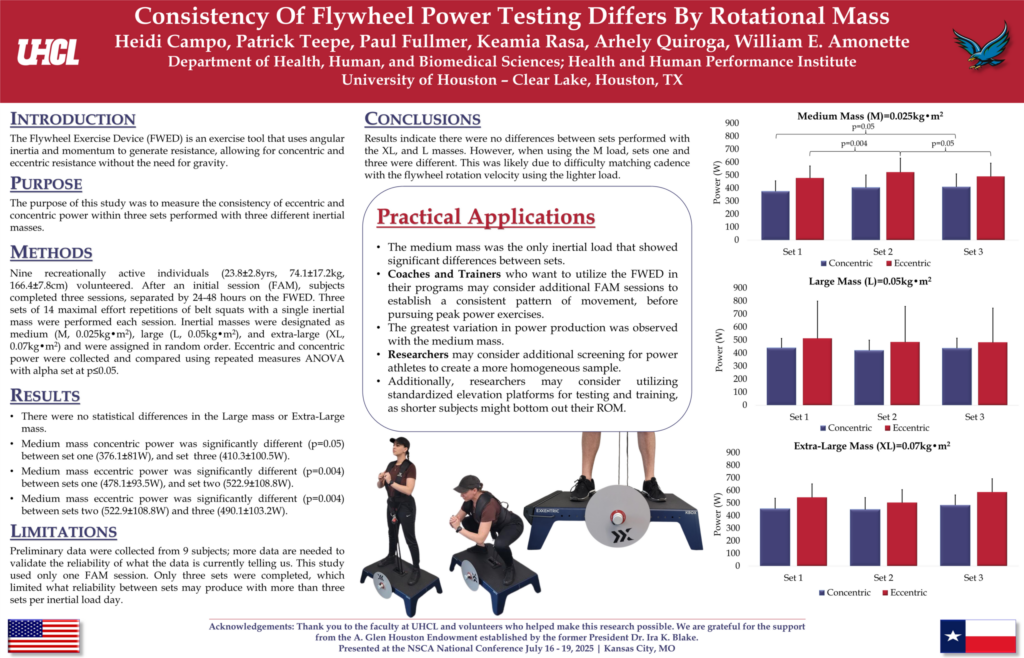
The purpose of this study was to measure the consistency of eccentric and concentric power within three sets performed with three different inertial masses.
Methods
Nine recreationally active individuals (23.8±2.8yrs, 74.1±17.2kg, 166.4±7.8cm) participated in four sessions. The first session consisted of subject intake, informed consent, anthropometric measurements, and a familiarization session on the flywheel with the belt squat exercise. The following three sessions occurred on separate days 24-28 hours apart and consisted of the same standardized warm up, followed by three sets of fourteen repetitions of belt squats on the flywheel. Subjects performed squats with either the medium (M)=0.025kg•m2, large (L)=0.05kg•m2, or extra-large (XL)=0.07kg•m2 inertial masses in random order. The first two repetitions were used to build rotational momentum before the participants performed 12 repetitions as hard and fast as possible. Subjects were provided with loud verbal encouragement to exert maximum effort on each repetition and were provided with 3-5min recovery between sets. Eccentric and concentric power were determined from a sensor placed on the flywheel, which was recorded in an application. Data were compared using repeated measures ANOVA with alpha set at p<0.05.
Results
When comparing sets one (455.3±83.4W), sets two (449.4±94.3W), and sets 3 (484.3±80.3W) within the XL mass, there were no significant differences in concentric power (p=0.58). Likewise, for eccentric power, there were no significant differences (p=0.15) between sets one (544.9±108.1W), two (503.4±103.5W), and three (587.4±106.1W). Within the L mass, there were no significant differences (p=0.46) in concentric power between sets one (440.8±72.1W), sets two (421.0±78.9W), and sets three (437.9±77.5W). For the eccentric power, there were no significant differences (p=0.27) between sets one (513.048±286.9W), two (484.8±274.3W), and sets three (482.5±263.8W). Within the M mass, there were significant differences between set three (410.3±317.7W), and set one (376.1±256.2W). For eccentric power, there were significant differences (p=0.004) between sets two and one (522.9±344.2W) and sets two and three (478.1±295.7W).
Conclusions
For initial lunar missions, astronauts will utilize a flywheel as an exclusive exercise countermeasure, performing both strength and metabolic conditioning exercises. One advantage to flywheel exercise is that both eccentric and concentric power can be identified and used as a training or outcome variable, but little is known about the reliability of these data. Results indicate there were no differences between sets performed with the XL, and L masses. However, when using the M load, sets one and three were different. This was likely due to difficulty matching cadence with the flywheel rotation velocity using the lighter load.
Practical Applications
Practice sets and repetitions may be necessary to establish a consistent pattern of movement, especially with lighter inertial masses.
Acknowledgements
None