
P. Teepe, H. Campo, K. Rasa, A. Quiroga, P. Fullmer, and W. Amonette.
Journal of Strength and Conditioning Research: 2025. DOI: 10.1519/JSC.0000000000005357
Purpose
The purpose of this project was to test eccentric and concentric power output, using three different inertial masses.
Methods
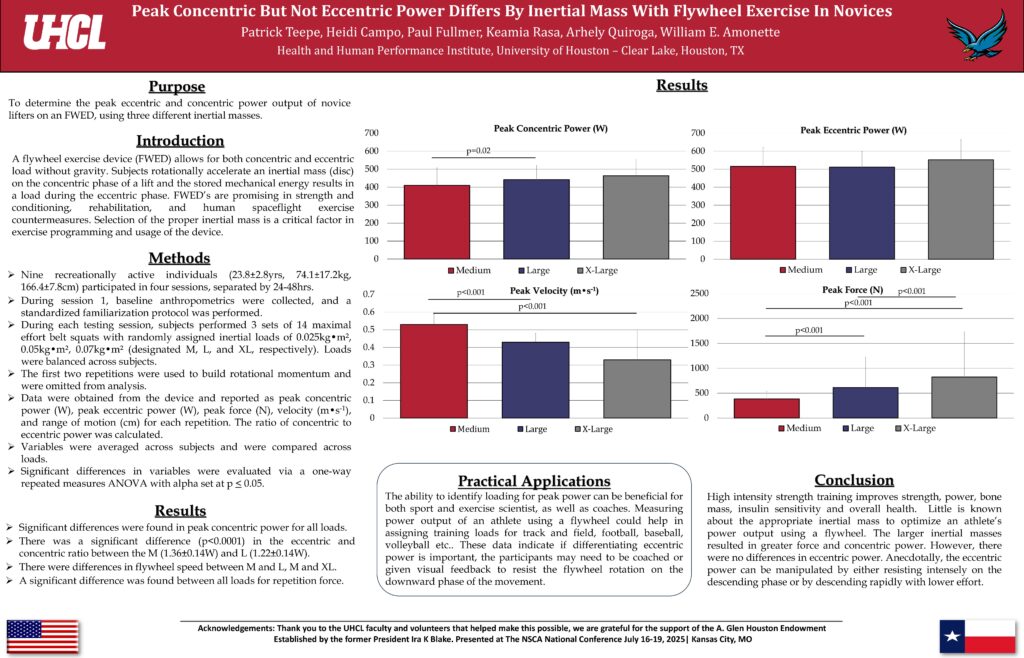
Nine recreationally active individuals (23.8±2.8yrs, 74.1±17.2kg, 166.4±7.8cm) participated in four sessions. They completed these sessions separated by 24-48 hours. The initial sessions consisted of baseline anthropometrics and a standardized familiarization session on the flywheel. In this session, the participants practiced by completing one set with two different inertial masses until they felt comfortable with the mechanics of the device. Returning to the lab for the second session, they were randomly assigned an inertial mass of: (M)=0.025kg•m2, (L)=0.05kg•m2, or (XL)=0.07kg•m2. Each time the participant returned to the lab, they were assigned a different inertial mass. During each session, participants completed 3×14 belt squats. The first two reps were omitted from analysis because they were used to build rotational momentum. Mechanical data were obtained from a sensor on the flywheel and reported the peak concentric and eccentric power, force, and range of motion. The ratio of eccentric to concentric power was calculated and compared as well.
Results
There was a significant difference in peak concentric power by load: L (441.8±77.8W) was greater than M (410.5±97.1W; p=.02) and XL (463.6±90.1W). The eccentric power for the XL, L, and M masses were 552.7 ±111.2W, 511.79±87.8W, 515.9±105.4W; respectively, with no significant differences between the conditions. There was a significant difference (p<0.0001) in the eccentric and concentric ratio between the M (1.36±0.14W) and L (1.22±0.14W) masses, but no other comparisons were significantly different. There were significant differences in flywheel speed between M (0.53±0.06 m•s-1;p< .001) and L (0.43±0.05 m•s-1; p< 0.001), M and XL (0.33±.17m•s-1; p< 0.001). There were no significant differences in loads for repetition velocity M (40.2±17.2W), L (39.1±16.3W) and XL (39.1±19.0W). A significant difference was found between all loads for repetition force, M (385.5± 151.8W; p< .001), L (614.4±607.6W; p< .001), XL (825.0± 907.1W; p< .001).
Conclusions
High intensity strength training improves strength, power, bone mass, insulin sensitivity and overall health. Astronauts use modified exercise equipment as a countermeasure to the loss of these health-related qualities. Unlike the international space station (ISS) where there is a suite of exercise hardware, lunar missions will utilize one mechanical flywheel for strength training and metabolic fitness. Little is known about the appropriate inertial mass to optimize a athlete’s power output using a flywheel. The larger inertial masses resulted in greater force and concentric power. However, there were no differences in eccentric power. Anecdotally, the eccentric power can be manipulated by either resisting intensely on the descending phase or by descending rapidly with lower effort.
Practical Applications
The ability to identify intensity for peak power can be beneficial for sports and performance scientists. These data indicate if differentiating eccentric power is important, the participants may need to be coached or given visual feedback to resist the flywheel rotation on the downward phase of the movement.
Acknowledgements
None