A. Quiroga, K. Rasa, H. Campo, P. Fullmer, P. Teepe, and W. Amonette.
Journal of Strength and Conditioning Research: 2025. DOI: 10.1519/JSC.0000000000005357
Purpose
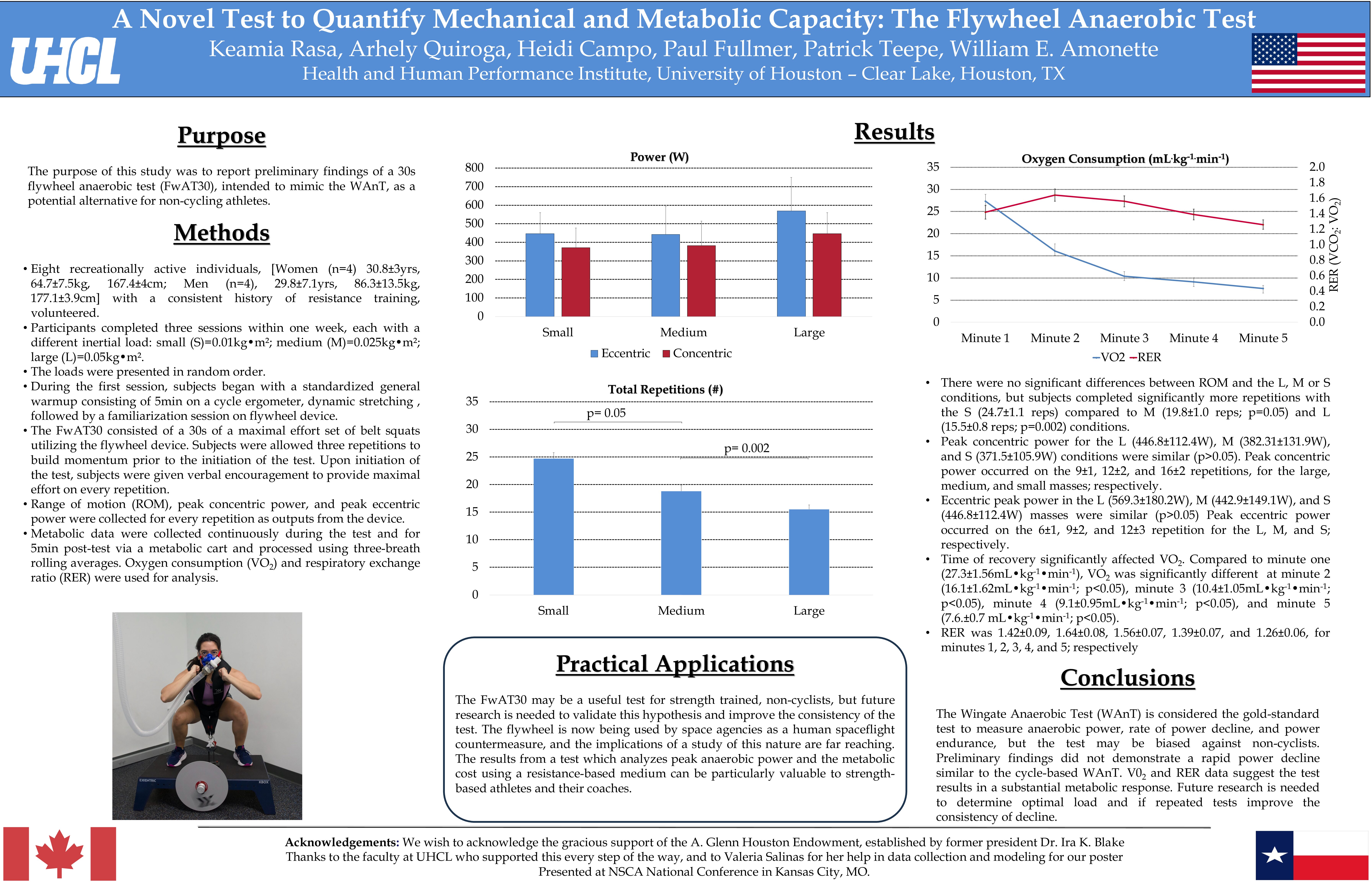
To compare four different gas sampling methods on metabolic and ventilatory variables during brief, high intensity effort and recovery.
Methods
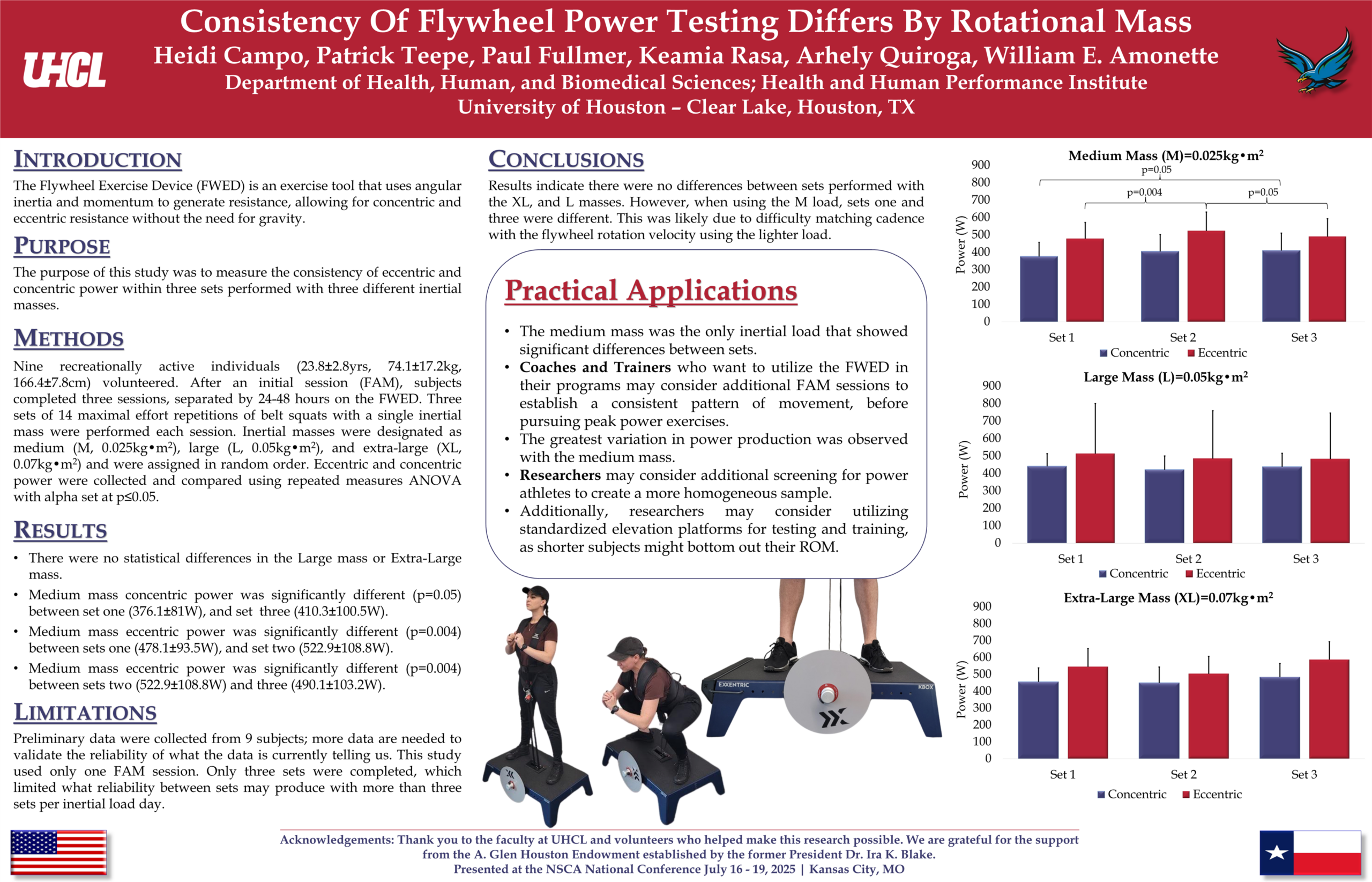
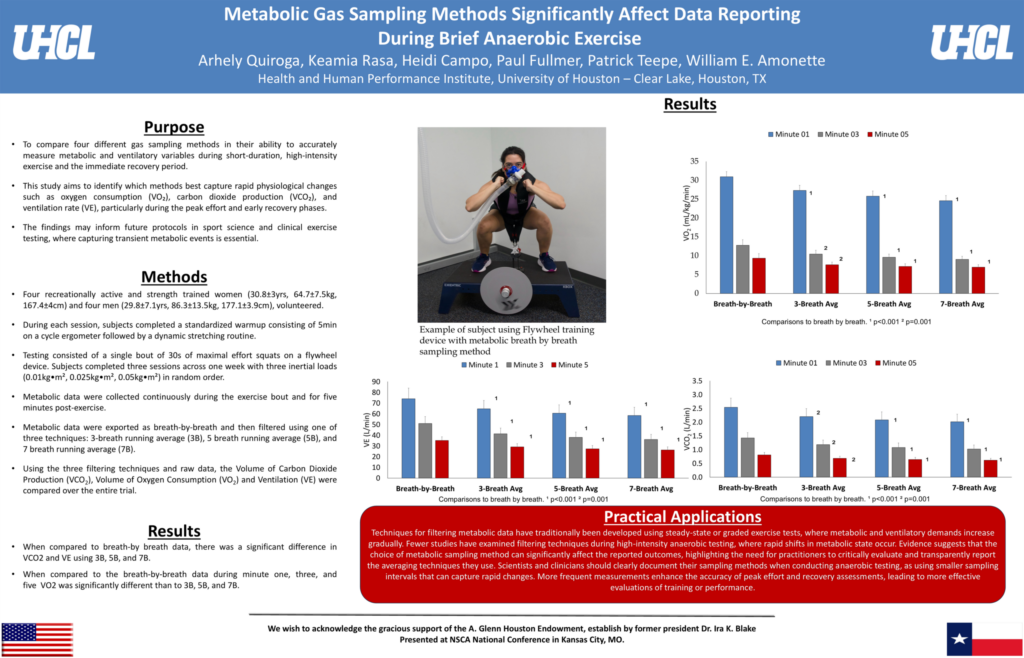
Four recreationally active and strength trained women (30.8±3yrs, 64.7±7.5kg, 167.4±4cm) and four men (29.8±7.1yrs, 86.3±13.5kg, 177.1±3.9cm), volunteered. In the initial session, participants signed an informed consent form approved by the Institutional Review Board prior to baseline data collection and completed a familiarization with the device. During each session, subjects completed a standardized warmup consisting of 5min on a cycle ergometer followed by a dynamic stretching routine. Testing consisted of a single bout of 30s of maximal effort squats on a flywheel device utilizing a harness. Subjects completed three sessions across one week with three inertial loads (0.01kg•m2; 0.025kg•m2, 0.05kg•m2) in random order. Metabolic data were collected continuously during the exercise bout and for five minutes post-exercise. Metabolic data were exported as breath-by-breath and then filtered using one of three techniques: 3-breath running average (3B), 5 breath running average (5B), and 7 breath running average (7B). Using the three filtering techniques and raw data, the Volume of Carbon Dioxide Production (VCO2), Volume of Oxygen Consumption (VO2) and Ventilation (VE) were compared over the entire trial. VO2 was compared in greater detail within minutes 1, 3, and 5.
Results
When compared to breath-by breath data (1.6±0.31L•min-1), there was a significant difference in VCO2 using 3B (1.4±0.3L•min-1; p=0.001), 5B (1.3±0.3L•min-1; p< 0.001), and 7B (1.2±0.3L•min-1; p< 0.001). Breath-by-breath VE (40.2±53.05L•min-1) was significantly different than 3B (44.8±7.28L•min-1; p< 0.001), 5B (41.8±6.9L•min-1; p< 0.001), and 7B (40.1±6.6L•min-1; p< 0.001). When compared to the breath-by-breath data (30.9±1.8mL•kg-1•min-1 during minute one, VO2 was significantly different using 3B (27.3±1.6mL•kg-1•min-1; p< 0.001), 5B (25.8±1.5mL•kg -1•min -1; p< 0.001), and 7B (24.5±1.4mL•kg -1•min-1; p< 0.001). A similar pattern persisted at minute three, where breath-by-breath (12.7±1.46mL•kg-1•min-1) data were significantly different than 3B (10.4±21.0mL•kg-1•min-1; p=0.001), 5B (9.57±0.89mL•kg-1•min-1; p< 0.001), and 7B (9.02±0.83mL•kg-1•min-1; p< 0.001).•min-1; p< 0.001). Within minute 5, breath-by-breath (9.3±1.2mL•kg-1•min-1) data were significantly different than 3B (7.6±0.7mL•kg-1•min-1•min-1; p=0.001), 5B (7.1±0.7mL•kg-1•min-1; p< 0.001), and 7B (6.9±0.67mL•kg-1•min-1; p< 0.001).
Conclusions
Techniques for filtering metabolic data have primarily been established using steady-state or graded exercise tests where there is a gradual increase in metabolic and ventilatory demand. However, fewer data exist describing filtering techniques during intense anaerobic testing, where there are rapid changes in the metabolic state. These data indicate that the metabolic sampling methods significantly alter the reported data and practitioners should critically assess and report the averaging techniques used to obtain outcome data.
Practical Applications
Sport scientists should use smaller interval sampling times when assessing anaerobic exercise to avoid missing important metabolic events that occur quickly with intense mechanical work.
Acknowledgements
None